
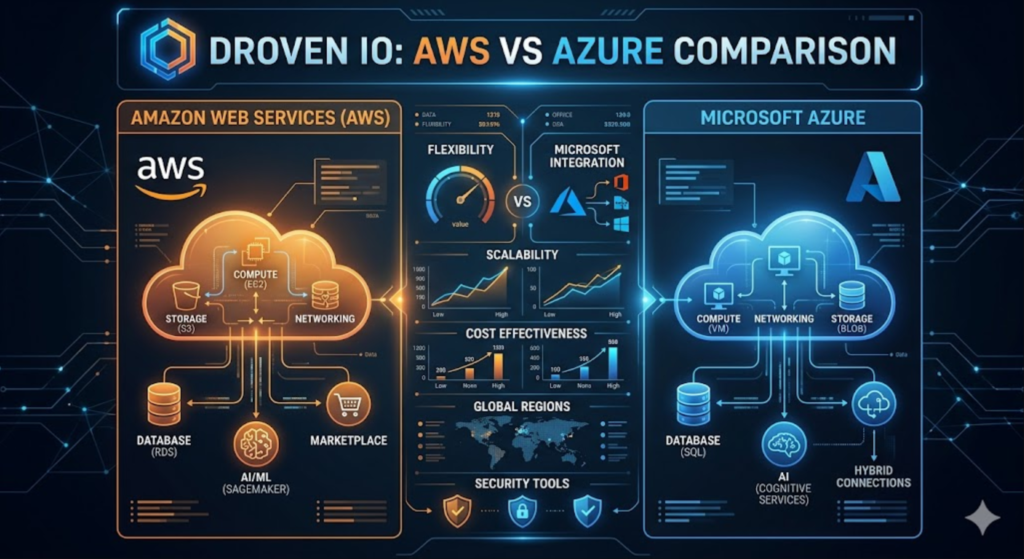
1. AWS and Azure offer different benefits to various types of organisations.
AWS offers flexibility and cloud-native capabilities, making it generally preferred by developers, start-ups, SaaS providers, and companies with high-traffic web applications.
Its strength lies in providing developers with control and enabling them to build simple sites or complex global applications, serverless systems, and customised architectures.
AWS has a significant presence globally.
• There are currently 123 available zones in 39 regions around the globe, and new ones will be coming online. However, given the sheer number of services in the AWS ecosystem, organisations must have a plan to avoid excessive spending on unnecessary services and complex architectures.
Azure is particularly suited to those who are already utilising Microsoft products such as Microsoft Office 365, Windows Server, Active Directory, and SQL Server.
It is designed to seamlessly integrate these products into a single platform, reducing the friction users experience when transitioning to a cloud environment. droven io aws vs azure comparison
As a result, Azure is an attractive option for companies involved in finance, health care, government, and other sectors where regulatory compliance is key.
Also, Microsoft has stated that Azure has more regions than any other cloud provider.
For organisations looking to transition from on-premises to cloud systems, Azure’s hybrid capabilities enable gradual, rather than complete, migrations.
From a Droven.io-style point of view
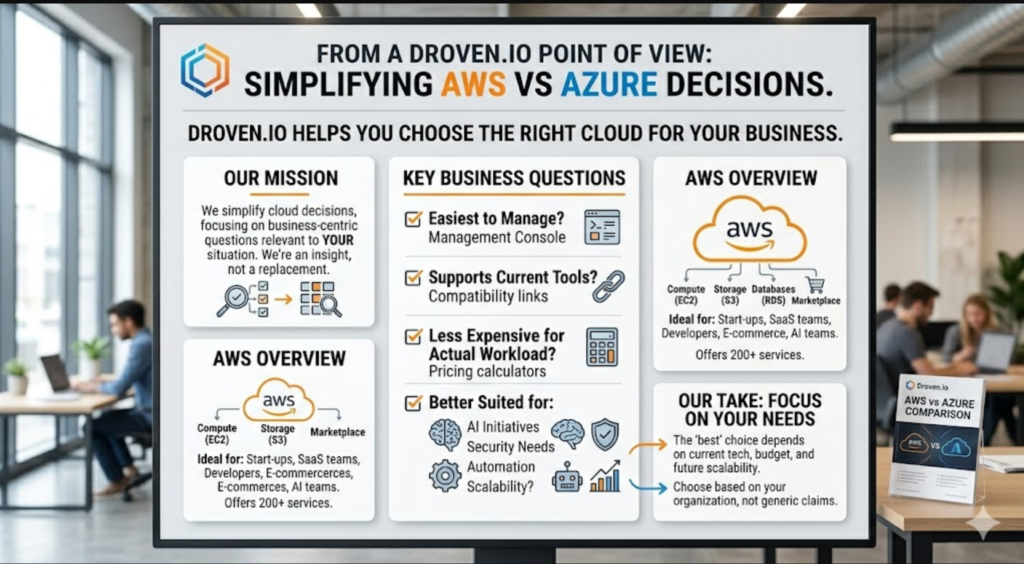
Droven.io is a technology-focused website that helps readers learn about topics such as cloud computing, artificial intelligence, automation, software development, cybersecurity, digital transformation, and the future of work.
Droven.io considers itself a source of AI information, tools, guides, and insight related to future technology, and its cloud computing category includes AWS, Azure, and Google Cloud.
Therefore, from an AWS vs Azure perspective, the Droven IO AWS vs Azure comparison does not intend to replace either cloud service provider.
1.1.1 Instead, Droven.io aims to help readers simplify decision-making about AWS and Azure.
A strong Droven.io AWS vs Azure comparison should be centred on business-centric questions relevant to a reader’s specific situation.
• Which cloud service would be easiest to manage?
• Is there a cloud service that supports my organisation’s current tools?
• Which cloud service would ultimately be less expensive for your organization’s actual
workload?
• Which cloud service would be better suited for my organisation’s AI initiatives, security needs, automation needs, and future scalability needs?
By focusing on business-centric questions rather than generic claims, a comparison of AWS and Azure becomes more beneficial to readers.
Ultimately, whether a reader chooses AWS or Azure depends on his/her/their organisation’s current technological environment, budget constraints, and desired level of future scalability.
AWS Overview
AWS is Amazon’s cloud computing platform that offers over 200 services across compute, storage, databases, networking, analytics, AI, and more.
AWS offers numerous pricing models across hundreds of eligible services and is widely recognised as having one of the largest ecosystems of cloud offerings.
Typically, AWS is best suited for start-ups, Software-as-a-service (SaaS) teams, developer-driven teams, e-commerce platforms, media companies, artificial intelligence (AI) teams, and high-traffic applications.
One of the greatest strengths of AWS is its flexibility.
Teams can create simple websites all the way up to complex applications running across multiple countries and continents.
Additionally, teams can create serverless applications, machine learning workflows, and highly customised infrastructure configurations.
On the other hand, the major drawback of AWS is its complexity.

With so many services available and the ability to customise each component, it can be overwhelming for teams to properly configure their cloud environment to take full advantage of what they’ve created.
Due to this complexity, teams require extensive planning before deploying their application(s) to avoid unnecessary costs associated with excess capacity.
Azure Overview
Azure is Microsoft’s cloud computing platform that also offers numerous services for compute, storage, database, networking, and analytics.
However, Azure is typically considered best suited for organisations that currently utilise Microsoft products such as Microsoft Office 365, Windows Server, and/or Active Directory.
Similar to AWS, Azure’s primary benefit is its integration with Microsoft products.
Because Azure was developed specifically with Microsoft products in mind, many processes required to implement Microsoft products in the cloud are greatly simplified.
For example, if you’re currently utilising Active Directory on-premises, implementing Azure Active Directory in the cloud allows you to leverage your existing identity system for authentication purposes.
Similarly, if you’re currently using SQL Server on-premises, Azure SQL Database in the cloud lets you leverage your existing database for relational database workloads.
Because of this seamless integration between on-premises and cloud-based solutions, Azure is particularly attractive to enterprise organisations that wish to migrate their on-premises solutions to the cloud.
Additionally, Azure is a great solution for government organisations that wish to meet strict regulations related to Identity and Access Management (IAM).
For example, healthcare organisations can use Azure’s compliance solutions to remain compliant with HIPAA regulations.
Similarly, financial institutions can use Azure’s compliance solutions to remain compliant with SOX regulations.
Azure’s hybrid capabilities allow organisations to gradually migrate their on-premises systems to the cloud, rather than migrating them all at once.
Droven IO AWS vs Azure Comparison Table

The table below outlines a summary comparison between the two clouds:
2 | Category | AWS | Azure |
| — | — | — |
| Flexibility | Stronger than Azure | Weaker than AWS |
| Integration with Other Products | Weaker than Azure | Stronger than AWS |
| Scalability | Stronger than Azure | Weaker than AWS |
| Cost Effectiveness | Stronger than Azure | Weaker than AWS |
1.1.2 AWS vs Azure Pricing: Which One Costs Less?
There isn’t a single “win” here since both AWS and Azure use usage-based pricing. Ultimately, though, the total cost depends on what you pay for (compute time/storage/data transfer/license fees, etc.), what region you run in, whether you purchase reserved instances/support plans/monitoring, etc., and finally, how committed you are to committing money to either provider over time.
AWS can be cost-effective if your team does a good job of managing your workload/resources/etc., turning off idle resources/reserving pricing, designing scalable architecture, etc. While AWS offers incredible pricing flexibility, it can be difficult for non-experts to monitor effectively.
Azure can be cost-effective if you are a heavy user of Microsoft products/you have a lot of existing licences/your organisation qualifies for special discounts, etc. If you qualify for these discounts/Azure Hybrid Benefit/etc. You could see your costs decrease.
You should compare costs by workload, NOT by name. There is nothing worse than having a poorly managed AWS setup and seeing huge bills. Similarly, there is nothing worse than having a poorly planned Azure setup and getting huge bills, too!
AWS vs Azure Performance
When Should I Choose AWS or Azure?

If you need more control over your cloud architecture/service selections/scaling/automation/customised infrastructure designs, then you probably need AWS.
If you need hybrid connectivity/access/integration with your Microsoft-based on-premises systems, then you probably need Azure.
Most organisations don’t really care which platform is “better”. What matters most is how well-architected your environment is, regardless of which provider you choose. A well-designed Azure environment can perform significantly better than a poorly planned AWS environment. Conversely, a well-designed AWS environment can outperform a poorly designed Azure environment.
AWS vs Azure Security
Both AWS and Azure provide robust security toolsets – however, as with most things related to security, it ultimately comes down to how well your cloud environment is configured, regardless of which provider you use.
Poor password management/poor access controls/unmonitored permission sets/exposed databases/insecurely set-up configurations, etc. – ALL apply equally well to BOTH platforms!
So while AWS might have some advantages in terms of fine-grained control over identity/access controls/network rules/etc., the same holds true for Azure – especially if you’re already using some form of MS Identity/MS Security product set.
Security ultimately depends on how well YOU manage access controls/permissions/monitoring/etc., regardless of which provider you use!
AWS vs Azure AI Tools
Artificial intelligence has now become one of the top drivers in cloud computing adoption.
AWS offers developers and data science teams a range of AI services/machine learning workflows/flexible model options.
Azure has advantages with regard to offering developers/members of data science teams who are working with AI-related tasks utilising Microsoft-AI-integrated workflows/OpenAI-related task workflows.
Additionally, businesses that already utilise Microsoft products (such as Microsoft Office 365/Windows Server/Active Directory/etc.) may find it easier to incorporate AI capabilities utilising their existing enterprise tools/productivity systems/business applications.
Therefore, while AWS offers greater flexibility for AI use, it appears that Microsoft-connected
AI adoption may be easier through Azure.

AWS Pros & Cons
Pros:
Extremely Broad Service Catalog
Ideal Platform for Developers/Cloud-Native Teams
Highly Customizable Infrastructure Designs
Best Choice for Start-ups/SaaS Platforms/Custom Apps
Robust Global Presence/Mature Cloud Offerings
Cons:
Greater Steepness-of-Learning-Curve-for-Beginners
Can Be Very Complex Regarding Pricing-without-Monitoring
Requires Greater Technical Planning-and-Design
Too Many Options Can Cause Confusion Among Smaller Teams
Azure Pros & Cons
Pros:
Seamlessly Integrates All Microsoft Products
Perfect Solution for Large Enterprises/IT Departments
Robust Hybrid Capabilities for On-Premise Connections
Excellent IDM/CMP Tools for Ease of Use
Easier for Teams Who Already Use Microsoft Technologies
Cons:
Less Suitable for Non-Microsoft Product-Based Teams
Still Can Be Complex in Regards to Pricing
May Feel Too Enterprise-Focused Regarding Some Services
Flexibility of customising the infrastructure may not be equal to that of AWS.
2.6 The Droven IO AWS vs. Azure comparison provides businesses,
Developers and IT teams, an overview of the similarities and differences between Amazon Web Services (AWS) and Microsoft Azure.
SQL
Is AWS better than Azure in 2026?
In summary, AWS is best suited for those requiring a high degree of flexibility, developing cloud-native applications, and seeking greater control over their infrastructure, as well as a vast library of services.
Azure, on the other hand, will be more suitable for organisations that use existing Microsoft solutions, desire to leverage hybrid clouds, or require tighter integrations with enterprise IT environments.
Is Azure better for a Microsoft-based business?
Yes, Azure is typically the preferred solution for businesses that utilise Microsoft products such as Microsoft 365, Windows Server, Active Directory, SQL Server, Teams, Power BI, or Microsoft security solutions.
Which is less expensive – AWS or Azure?
There isn’t an obvious answer to this question. While AWS can be more economical when used effectively with highly scalable, cloud-native workloads, Azure may offer savings for organizations with existing Microsoft licenses or enterprise agreements.
Which cloud platform is best for start-ups?
AWS appears to offer several advantages for start-ups. The combination of its ability to scale as needed and a wide variety of cloud services available makes it attractive for early-stage companies developing SaaS products, apps, marketplaces, or custom platforms.
Which is better for artificial intelligence (AI) — AWS or Azure?
AWS seems to be a preferable option for teams seeking flexibility in AI. Services as well as multiple machine learning tools. On the other hand, Azure may be a better fit for companies that want tighter integration between Microsoft AI and OpenAI workflows.
Is AWS more difficult to learn than Azure?
While AWS can appear overwhelming to new users due to its extensive service catalogue and various configurations, it may seem simpler to teams familiar with Microsoft products, Windows systems, Active Directory, Visual Studio, or Microsoft 365.